
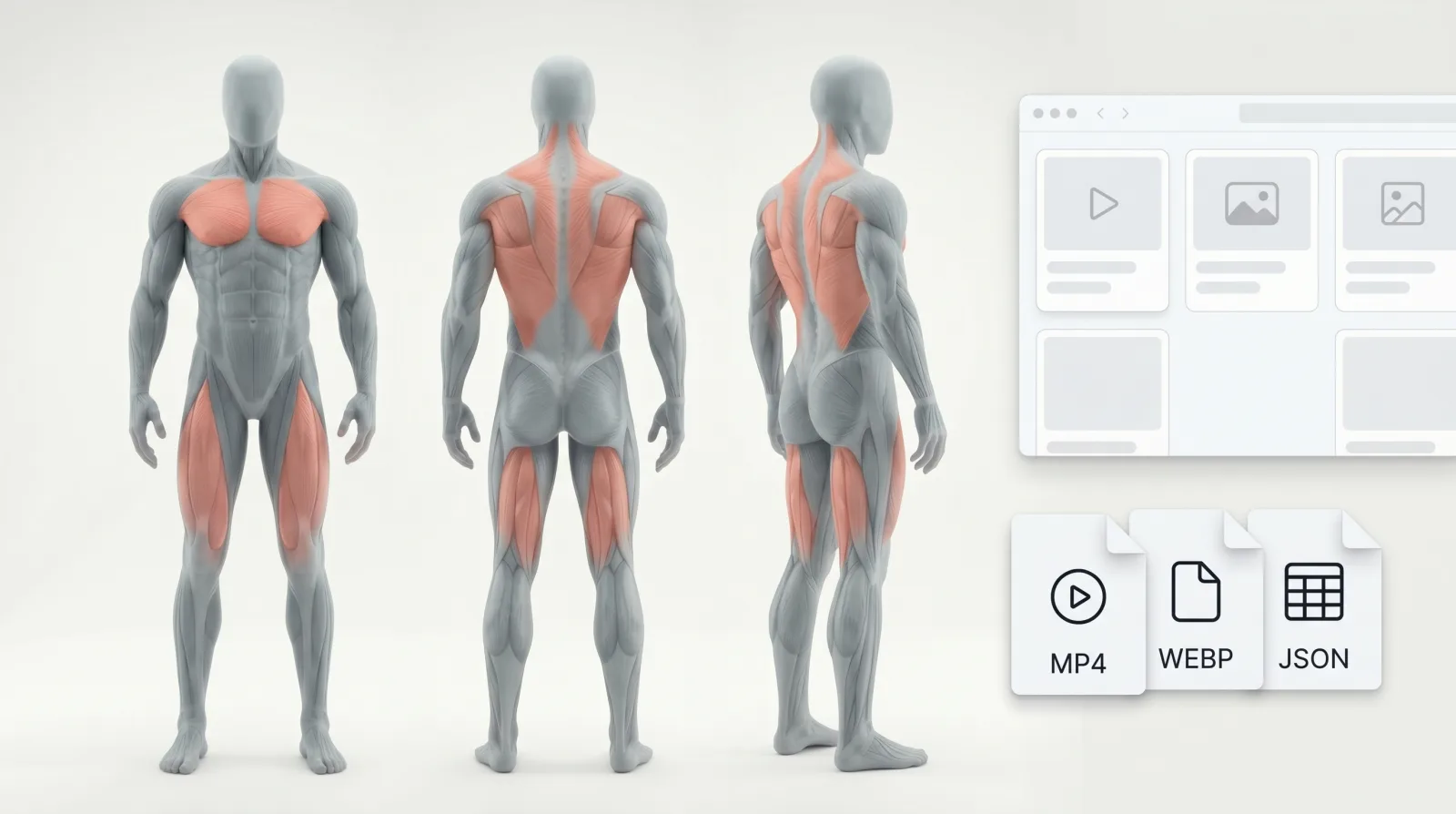
Before you commit to a content stack, decide whether your fitness app should build, license, or buy a white-label exercise media library that you can legally ship inside your own product.
Quick Answer
What is a white-label exercise library for fitness apps?
It is a licensed set of exercise videos, posters, and metadata that a fitness app can brand and ship inside its own product. The best fit depends on license scope, self-hosting rights, file formats, metadata, visual consistency, and whether the provider is selling app media, hosted API content, or coach-program materials.
- •Look for licensed movement media, not just exercise names
- •Evaluate rights, file delivery, self-hosting, posters, metadata, and style consistency
- •Decide between downloadable app media and hosted API content based on what your team controls
If you are building a fitness app, start with MoveKit for fitness app builders, then use this guide to audit whether the license and delivery model fit your product. When you reach the proof section, you can inspect the actual exercise catalog and judge the media yourself.
Quick answer: what counts as a white-label exercise library?
White-label means you can brand and ship the assets as part of your own product. For a fitness app, that is a narrow definition with real consequences. A directory of exercise names is not a library you can ship. What you need is licensed movement media: video clips your app can play, poster frames for fallbacks and thumbnails, and structured metadata your code can index.
Providers in this space sell three very different things, and the word white-label gets applied to all of them. Some sell hosted video accessed through an API or CDN. Some sell coach and program bundles aimed at trainers, not app code. Some sell downloadable app media that your product owns and self-hosts. Knowing which one you are buying is the first procurement decision.
An API can be useful when the provider is your content infrastructure. It is worth noting up front that MoveKit API access is waitlist only and is not a live public API. The current purchasable MoveKit product is downloadable, self-hostable media, which is what most app teams can ship with today.
Building a fitness app?
Start with the MoveKit page built for app builders, then use this guide to audit the license and delivery model before you commit.
Buy, build, or license: the real decision
The right framing is not a provider ranking. It is a tradeoff between cost, speed, risk, rights, and integration. Three routes are realistic for a fitness app.
Building in-house gives maximum control over talent, camera style, and unique movements. It also means filming, editing, QA, model and style consistency across a growing set, hosting, legal releases, and ongoing maintenance every time you add an exercise. That overhead is easy to underestimate and hard to reverse once your catalog grows.
Hosted white-label platforms reduce build work by managing the content for you. The cost is vendor dependency: you inherit their uptime, pricing changes, data model, and delivery constraints, and you may not receive raw asset ownership or self-hosting control.
Licensed downloadable media is often the fastest route when your team already owns the product and just needs consistent movement assets. You get files you can cache, brand, and ship, provided the license permits it. MoveKit is the example used throughout this guide for that licensed, self-hostable approach, and every MoveKit claim here is limited to verified facts.
Buy, build, or license: a decision matrix for exercise media
| Option | Best when | Main risk | Procurement question |
|---|---|---|---|
| Build in-house | You need custom talent, camera style, or unique movements | High production and legal overhead | Can you afford reshoots, QA, releases, and editing? |
| Hosted content / API provider | You want a managed content platform | Vendor dependency and recurring delivery constraints | Do you get the rights and integration model your app needs? |
| Licensed self-hostable library | You need app-ready media files and control over delivery | Provider quality and license scope must be verified | Can you self-host, brand, and ship the assets legally? |
The licensing questions to settle before you buy
License scope is the part teams skip and regret. Royalty-free and white-label are marketing words, not contract terms. Before any purchase, get clear written answers to a short list of questions, because the wrong answer can force a rebuild after launch.
Can the assets be used in paid apps, freemium apps, subscription products, client projects, courses, ads, and commercial products? Can you self-host the files and serve them to authenticated users through your own CDN or signed URLs? Can you resize, crop, recolor, rename internally, composite, or add overlays inside your product? Are you forbidden from reselling raw files, building a competing library, sharing raw links publicly, or using assets as AI training data? For white-label or agency work, is a separate license required per distinct branded app?
Allowed
- ✓Paid apps, freemium apps, subscriptions, websites, client projects, courses, videos, ads, and commercial products
- ✓Self-hosting for authenticated users via your own CDN or signed URLs
- ✓Internal resizing, cropping, recoloring, renaming, compositing, and overlays inside your product
- ✓White-label or agency use under one license per distinct branded app
Not Allowed
- ✗Reselling or repackaging the raw MP4, poster, or metadata files as a standalone asset pack
- ✗Building a competing stock library or public download catalog from the raw assets
- ✗Sharing raw download links or raw files publicly with unauthorized users
- ✗Using the animations as AI training data or as a basis for AI-generated derivative content
Scope summarized from the MoveKit license. Confirm the current license text for your specific use before signing.
If these are the questions your team is asking, the MoveKit fitness-app-builder page is the correct product surface to continue from, because the licensing and delivery model is built for exactly this buyer.
Self-hosted media versus API-delivered content
API and CDN language shows up across this SERP. Some providers, including YMove and Hyperhuman, lead with API or hosted delivery as their primary model. That can be the right choice when the provider is meant to be your content infrastructure.
An API also adds questions a downloadable library does not: uptime, pricing tiers, the provider data model, and ongoing vendor dependency. If the content service goes down or changes terms, your app feels it. A self-hostable MP4, poster, and metadata library puts caching, signed URLs, CDN behavior, offline strategy, and product taxonomy under your control instead.
MoveKit currently fits the self-hostable model. Paid videos are H.264 MP4 files, posters are separate WebP artifacts, and metadata ships as separate JSON and CSV artifacts. Individual paid videos stream through an authenticated download API, and pack downloads are delivered as private archives with per-click signed URLs after an entitlement check. Public API access is waitlist only.
ℹ️This is not a MoveKit API article
MoveKit API access is waitlist only and not live. The point here is that app teams can ship today with licensed downloadable media and self-hosting rights, without waiting on a public API.
What current providers actually sell
The SERP for white-label exercise media blends categories that solve different problems. Sorting them by what they actually deliver is more useful than ranking them, because most of them are not direct substitutes.
YMove positions as a direct exercise video library with white-label and API language. Its page lists HD videos, muscle-group coverage, exercise instructions, and API access, with a free starter tier and a paid API integration tier. White Label Workouts sells a coach and program bundle: its product page lists packs of unique exercises and workouts with downloadable, editable resources, which is content for trainers more than app code. Fitterstock is a broad licensed fitness and wellness stock library with advanced filtering, useful when you want variety beyond a focused exercise set. Hyperhuman is the strongest article-style competitor, leading with an AI-ready content library, smart metadata, localization, and API delivery. Central Athlete is a large licensed exercise video library aimed at businesses, with tiered licensing and a lead-form sales motion.
White-label app builder pages such as Passion.io also rank here, because buyers think about the app shell at the same time as the media. Those pages answer platform and monetization questions, not exercise media procurement, so they do not settle the content decision by themselves.
Provider taxonomy: what each source type is actually selling
| Source type | Examples | Good for | Gap for app builders |
|---|---|---|---|
| Exercise video / API library | YMove, Hyperhuman | Managed content access and API-led delivery | May add vendor dependency or unclear raw-file ownership |
| Coach content bundle | White Label Workouts | Programs, explainers, coaching resources | Not necessarily app-ready MP4, poster, and metadata delivery |
| Stock wellness library | Fitterstock | Broad health and wellness media variety | Can be too broad for a consistent exercise app UI |
| Licensed self-hostable app media | MoveKit | Teams that need files, posters, metadata, and commercial rights | Requires the buyer to handle product integration and hosting |
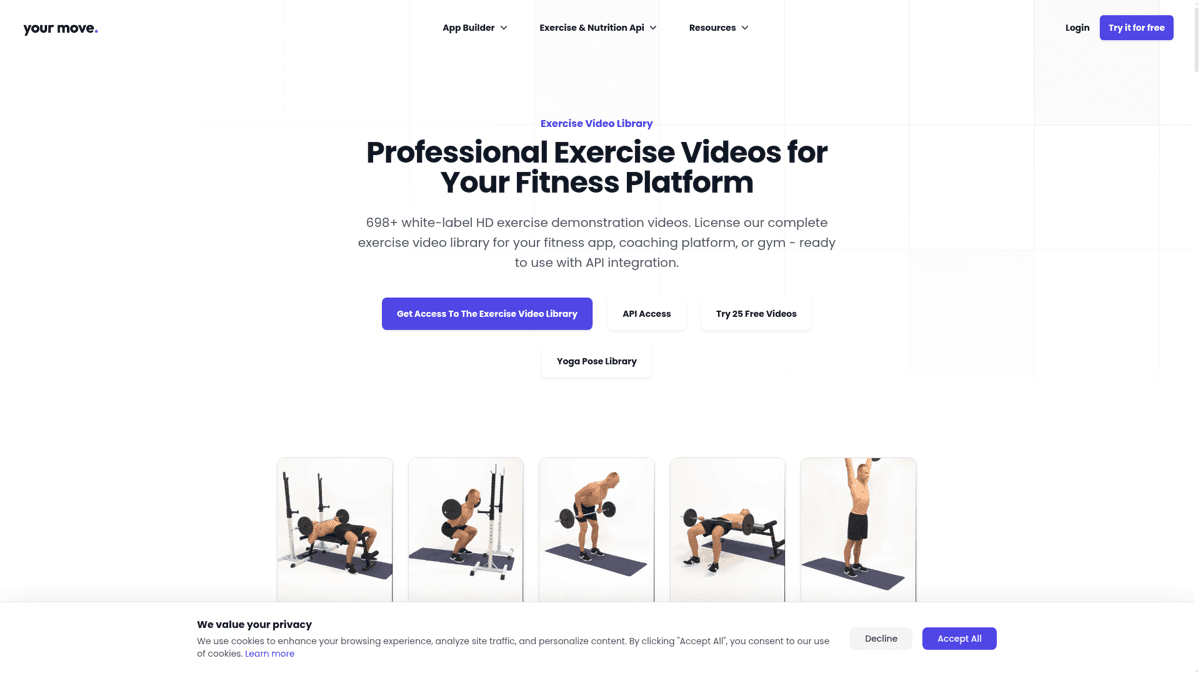
YMove leads with white-label HD videos and API access.
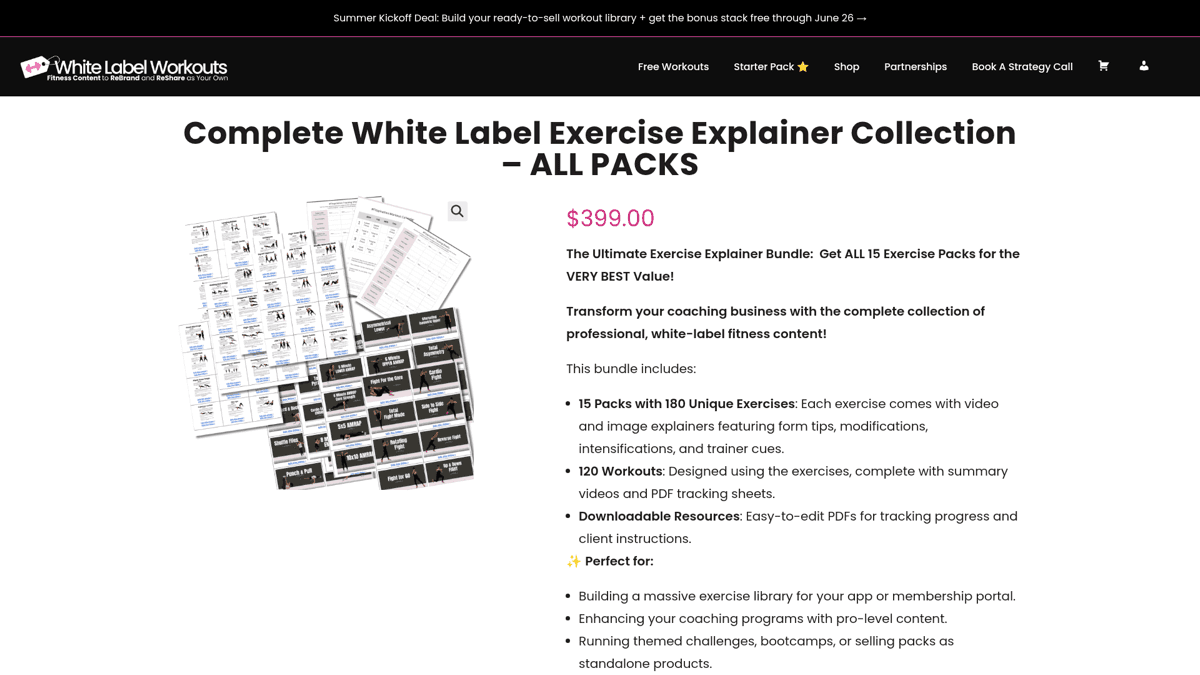
White Label Workouts sells editable coach and program bundles.
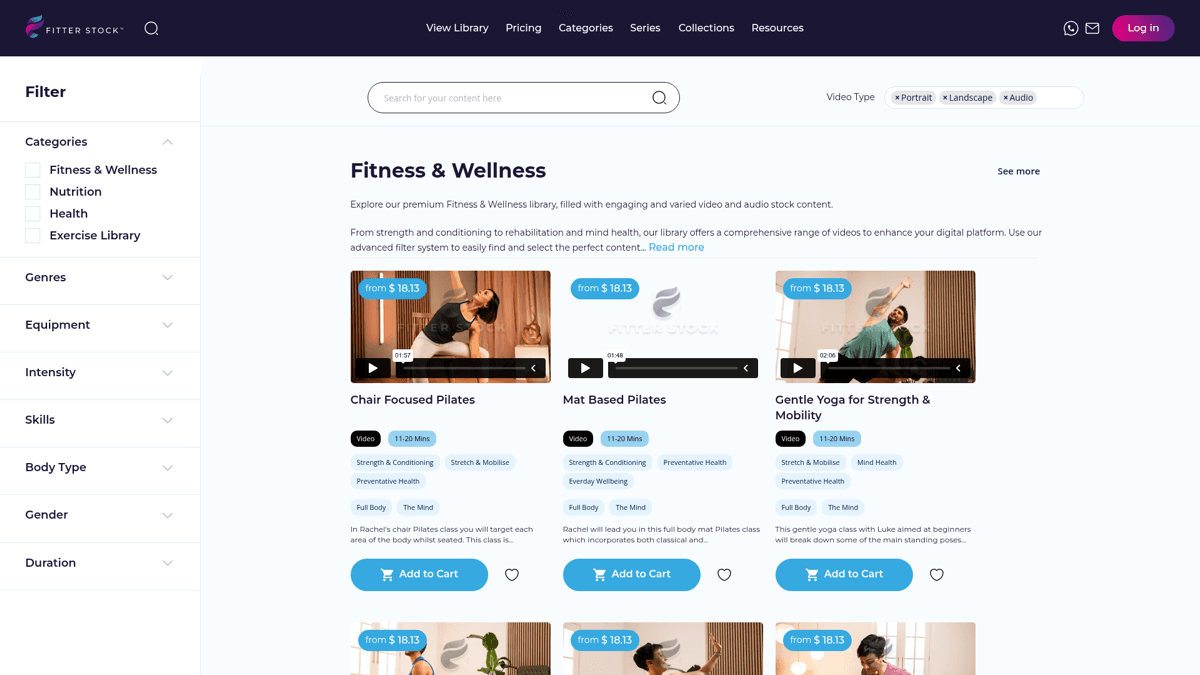
Fitterstock is broad licensed fitness and wellness stock media.
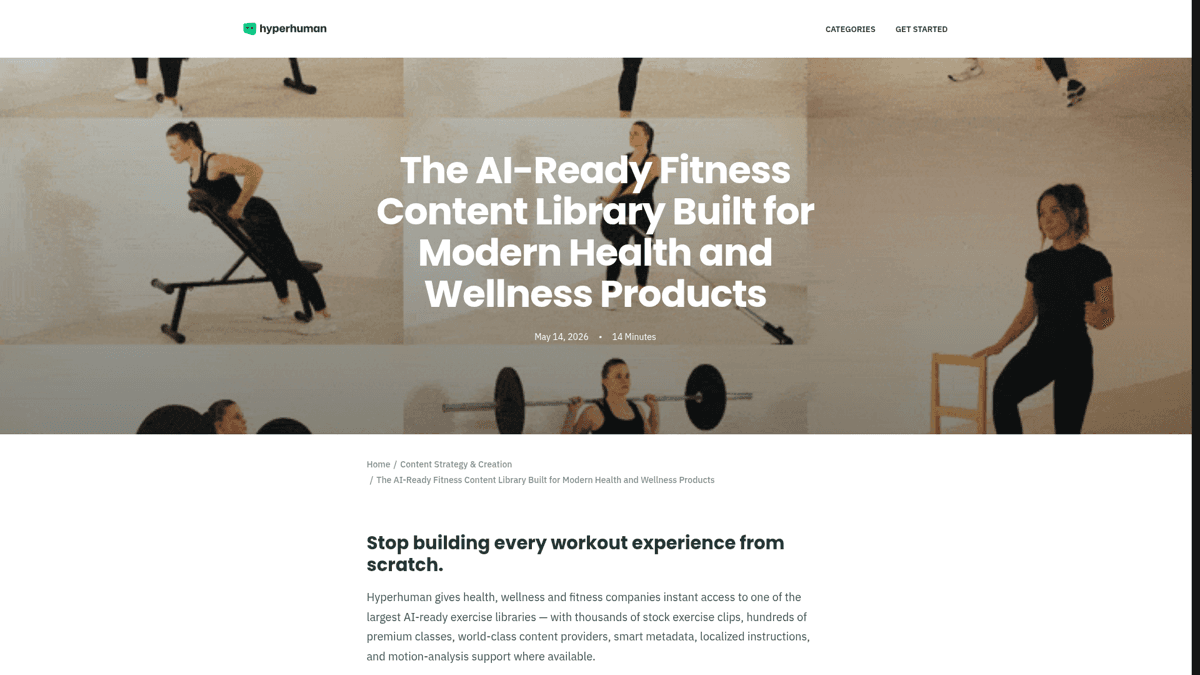
Hyperhuman leads with an AI-ready content library and API delivery.
MoveKit fit: licensed movement media for app builders
MoveKit is a premium 3D exercise animation library for fitness app developers, coaching platforms, content creators, and agencies. Instead of describing it, here are three real clips embedded live from the current catalog so you can judge motion, camera angle, and style consistency yourself. Competitors rarely let you inspect the actual media inside the article.
Live MoveKit previews
Barbell Squat
Dumbbell Chest Fly
Pull Ups
On the product facts: the catalog has 582 exercises, marketed as 400+ animations. Individual clips are $4.99 and all current exercises share that price, so you can start with a handful and scale. Four nested buyer libraries run from the 155-exercise Starter Pack at $149 to the 582-exercise Complete Pack at $299. New pack purchases include 12 months of qualifying new releases, while every file added to the buyer's library stays licensed permanently. Paid videos are H.264 MP4, posters are separate WebP artifacts, and metadata ships as separate JSON and CSV files keyed by slug, so your app can index movement, muscles, equipment, difficulty, and more. Self-hosting is allowed for authenticated users, including through your own CDN or signed URLs.
Inspect the real library before you choose
Browse the actual MoveKit catalog and check motion, posters, and metadata against your app requirements.
Procurement checklist before you sign
Use this as a reusable evaluation list whether or not you choose MoveKit. A provider that cannot answer these clearly is a risk, regardless of how good the thumbnails look.
Ask for exact license scope and forbidden uses in writing. Confirm whether you receive files, API access, hosted embeds, or a managed platform. Check whether posters, metadata, and written exercise text are included or delivered separately. Confirm whether self-hosting, authenticated delivery, and client-branded apps are allowed. Ask how updates, new exercises, refunds, defects, custom gaps, and support response times work. Reject providers that cannot explain commercial use, redistribution rules, raw-file delivery, or AI-training restrictions.
What good looks like in an exercise media provider
Pros
- ✓Clear commercial license with forbidden uses spelled out
- ✓Raw files or explicit self-hosting rights
- ✓Posters and metadata included or separately delivered
- ✓Consistent visual style across the whole set
- ✓Transparent pack or per-clip pricing
Cons
- ✗Vague royalty-free language with no scope detail
- ✗No redistribution restrictions explained
- ✗Only screenshots or thumbnails, no real previews
- ✗No metadata handoff for your app to index
- ✗Public API claims without docs or uptime terms
When a white-label library is not the right choice
Licensed media is not always the answer, and being honest about that protects your launch. A few cases call for a different decision.
If your app needs unique branded talent, custom camera direction, or named instructors, build or commission the content. If the business needs full platform operations, payments, messaging, and memberships, a white-label app builder may matter more than media licensing. If you want free public exercise content or stock clipart, a premium licensed library is not the right fit. And if you need a live public exercise API today, hold to waitlist and current-status language rather than overstating what any provider offers.
⚠️A library is not a full app platform
Licensed media solves the exercise-content layer. It does not replace your app builder, coaching platform, payments, memberships, or workout logic.
FAQ
Can I use MoveKit in a white-label fitness app?
Yes. White-label and agency use is supported under one license per distinct branded app, so you can build separate client-branded end-products. Confirm the current license text for the specific number of branded apps you plan to ship.
Can I self-host MoveKit exercise videos?
Yes. Self-hosting the files and serving them to authenticated users is allowed, including through your own CDN or signed URLs. That gives your app control over caching, delivery, and offline behavior.
Does MoveKit have a public exercise API?
No. API access is coming soon and is waitlist only. There is no live public MoveKit API, SDK, webhook system, or search endpoint today. The current product is downloadable, self-hostable media.
Is it cheaper to build exercise videos in-house or license a library?
It depends on scope. Building in-house gives full control but adds filming, editing, legal releases, QA, and ongoing maintenance as your catalog grows. Licensing is usually faster to ship when the license scope and delivery model fit your product, because the production work is already done.
What files should an exercise library provide for app builders?
At minimum, video clips your app can play, poster frames for thumbnails and fallbacks, and structured metadata your code can index. MoveKit provides H.264 MP4 videos, separate WebP posters, and separate JSON and CSV metadata artifacts that join on slug.
Make the media layer the easy part
When the exercise-content layer is your bottleneck, use MoveKit as the licensed exercise animation layer for your fitness app: self-hostable media, posters, metadata, and commercial rights.
MoveKit for fitness app builders →Key takeaways
- ✓A shippable white-label exercise library means licensed video, posters, and metadata, not just exercise names.
- ✓Decide between build, hosted API, and licensed self-hostable media based on control, speed, and vendor risk.
- ✓License scope is the make-or-break detail: commercial use, self-hosting, and per-branded-app terms must be in writing.
- ✓MoveKit ships licensed H.264 MP4 clips, separate WebP posters, and JSON/CSV metadata you can self-host. API access is waitlist only.