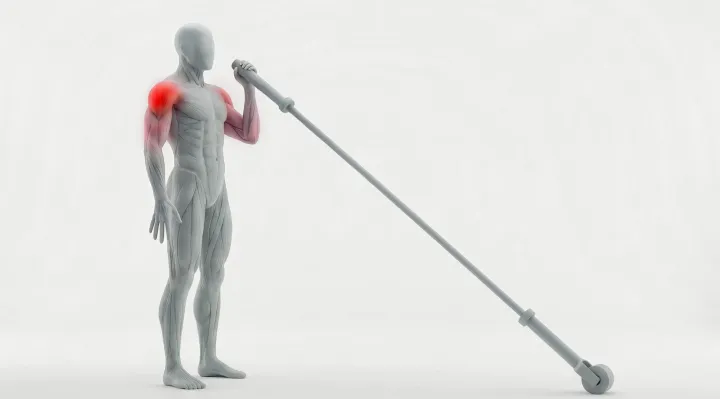
Behind-the-Neck Press
What you'll gain
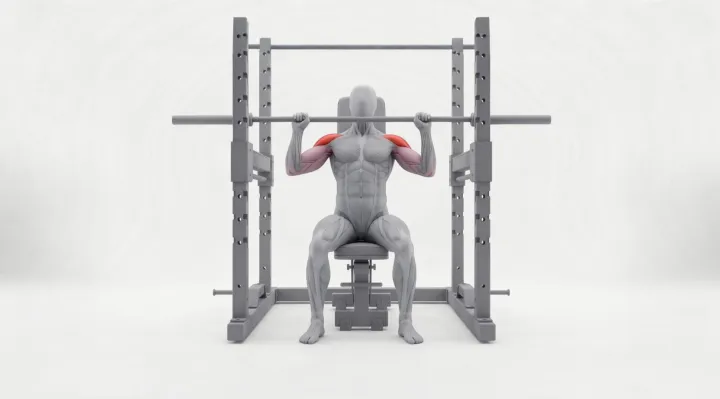
Keeps the bar path vertical, which places steady demand on the lateral deltoid.
Exposes shoulder and thoracic mobility limits that front pressing can mask.
Builds overhead stability for lifters who already press comfortably from the front.
Step-by-Step Instructions
- 1
Set a barbell in a rack just below shoulder height and load a conservative weight.
- 2
Step under the bar and hold it behind your head around ear height with a grip wider than shoulder width.
- 3
Stand tall, brace your abdominals and glutes, then take two steps back from the rack.
- 4
Press the bar straight overhead, keeping the torso upright and the chin tucked.
- 5
Lock out with the bar over the middle of your head and your ears close to your arms.
- 6
Lower the bar under control back behind your head to around ear height and repeat only while form holds.
Common Mistakes
Attempting the lift without full overhead mobility, which forces the head forward and strains the shoulder.
Dropping the bar quickly onto the traps, which risks contact with the neck and head.
Using leg drive, which turns a strict press into a push press and hides a load that is too heavy.
Leaning back to finish the rep, which shifts the load onto the lower back.
About This Exercise
The behind-the-neck press starts with the barbell held behind the head around ear height, above the shoulders. Pressing from there keeps the bar path vertical and biases the lateral deltoid, but it also puts the shoulder into full external rotation and abduction for the entire lift. That position is only safe for lifters who already own the overhead mobility, so the movement is treated as an advanced progression rather than a default shoulder builder. Triceps finish the lockout and the traps and trunk stabilize the load throughout. For an asset library this clip is useful precisely because the position is hard to describe in text. Coaching platforms can use it in shoulder mobility screening content, and app libraries can attach it to advanced pressing tiers with an explicit prerequisite gate.
Looking for an exercise animation collection for your app, coaching platform, or content workflow? MoveKit gives you consistent quality across every movement so your product feels cohesive from first launch through scale.
Build faster with related MoveKit resources
An overhead barbell press with the bar racked behind the neck, demanding full shoulder and thoracic mobility.
Need more than one animation?
Compare our packs to find the right fit, all with commercial licensing included.
Specifications
Built for
- Advanced pressing tiers in strength app progression trees.
- Shoulder mobility screening and prerequisite content for coaching platforms.
- Technique comparison media contrasting front rack and behind-the-neck rack positions.
- Editorial content on why behind-the-neck pressing needs a mobility gate.